
Mecklenburg Court Records After Jail Arrest
Court records after a jail arrest in Mecklenburg County, Virginia, are not the same as the booking record. The booking record is tied to custody at Meherrin River Regional Jail, the regional jail authority serving Mecklenburg, Brunswick, and Dinwiddie. It may show a booking date, charge text, bond fields, warrant number, and court-related fields if the public roster is configured to show them. The court record begins when a charge is filed, heard, or moved into the Virginia court system.
The local court structure matters. Mecklenburg General District Court handles misdemeanors, traffic cases, and preliminary hearings for felonies. Mecklenburg Circuit Court handles felony trials, indictments, appeals from lower courts, and the broad trial-court work assigned by Virginia law. Juvenile and Domestic Relations District Court handles juvenile and family matters, with more limits on public access. For custody and booking detail, use the Mecklenburg County jail inmate records page. For booking-photo questions, use the Mecklenburg County jail mugshots page.
The Mecklenburg County Commonwealth's Attorney represents the people of the county in criminal prosecutions. Virginia uses the title Commonwealth's Attorney rather than District Attorney. The office presents evidence in court against persons charged with crimes, so a filed court charge may not match the first charge label seen on a jail roster.
Find Mecklenburg Court Records
The main search route for court records after a Mecklenburg County arrest is the Virginia Court System case information hub. Start there and choose the court level that fits the case. A fresh misdemeanor or preliminary felony matter usually starts with General District Court Online Case Information. A felony indictment, Circuit Court trial, or appeal from General District Court may require the Circuit Court Case Information System.
The Mecklenburg courts overview is a useful local source because it separates Circuit Court, General District Court, Juvenile and Domestic Relations District Court, Juvenile Court Services, and Piedmont Court Services. The court search portals do not replace the jail roster. They answer a different question: what has been filed in court, which hearings are set, and how each charge is moving.
| Portal | Search Route | Type | Required | Notes |
|---|---|---|---|---|
| Case Status and Information hub | Select court system | Link or menu | Yes | Choose Circuit, General District, or JDR where public access is available. |
| General District Court | Locality | Dropdown | Yes | Select Mecklenburg General District Court for most new misdemeanor and preliminary felony matters. |
| General District Court | Name | Text | One route | Use the defendant name from booking paperwork or roster details. |
| General District Court | Case number | Text | One route | Best when the summons, warrant, or court paperwork lists the number. |
| General District Court | Hearing date | Date | One route | Useful when a name is common or a first appearance date is known. |
| Circuit Court | Locality or court | Dropdown | Yes | Select Mecklenburg Circuit Court if the case has moved to Circuit Court. |
| Circuit Court | Name, case number, or hearing date | Text or date | One route | Use for felony indictments, Circuit Court proceedings, and appeals. |
Lookup After Jail Arrest
A Mecklenburg County court records search works best when the custody record and the court record are read together. MRRJ can confirm whether a person is in regional jail custody after an arrest. The Virginia courts portals show what has been filed in General District or Circuit Court. If the arrest is very recent, the person may be booked before the court case is fully searchable.
- Confirm current custody with the MRRJ Current Offenders roster or the jail's main number if the arrest just happened.
- Identify the likely court level. Misdemeanors and preliminary felony hearings usually start in General District Court.
- Use the Virginia court case information hub and select the Mecklenburg court that matches the case type.
- Search by defendant name first. Narrow by hearing date or case number if the result list is too broad.
- Open the case and compare each court charge with the roster charge, bond entry, court date, warrant number, or case number.
- For older, sealed, expunged, or non-online files, contact the clerk or the Commonwealth's Attorney contact listed for prosecution records.
For prosecution-record FOIA questions, the Commonwealth's Attorney page lists Brian Butler by email and by phone at 434-738-6191 ext. 4350. For jail records held by MRRJ, the FOIA path is the MRRJ FOIA Officer rather than the court portal.
The Virginia courts case-information hub shows the court search entry points used for Mecklenburg County court records after an arrest.
The official Virginia case-information hub is the source for the screenshot below.
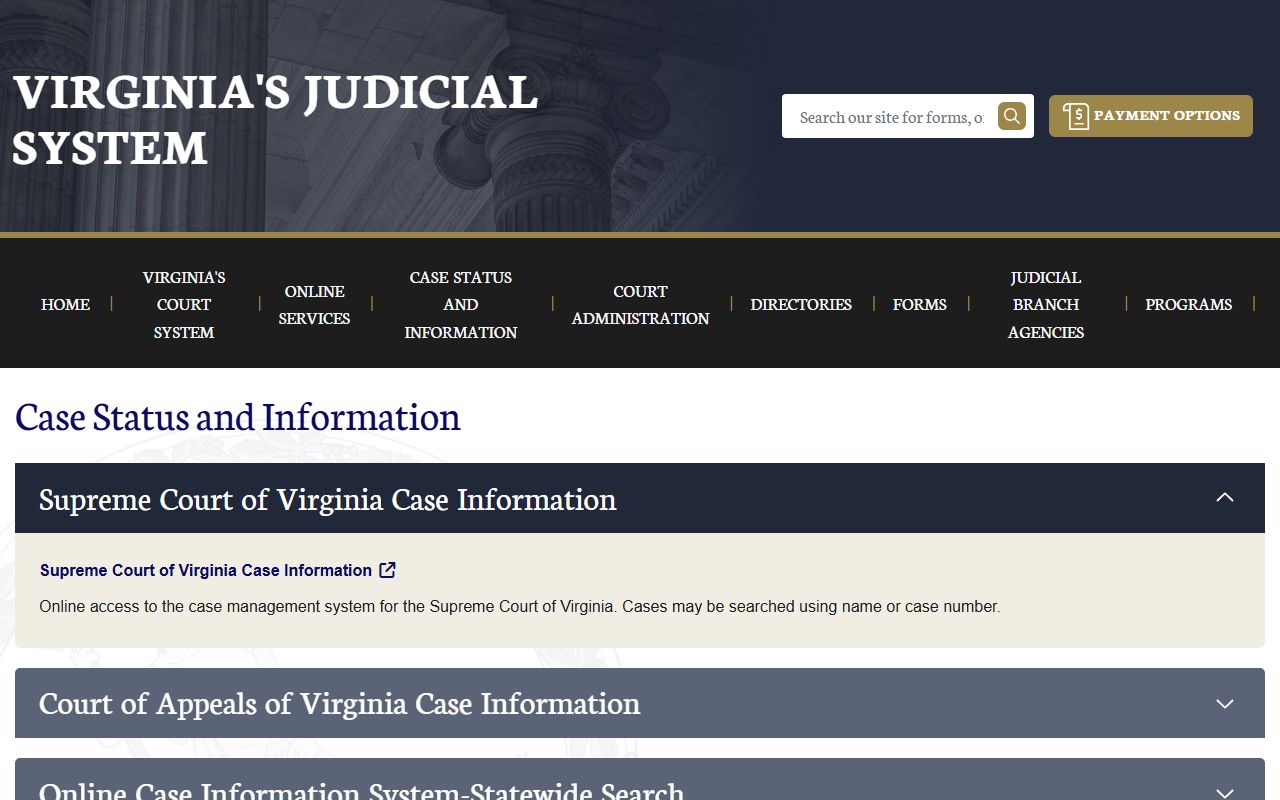
Use the hub as the court-record side of the lookup, then use MRRJ only for the custody and booking side.
Mecklenburg Charging Documents
After a jail arrest, the charge reaches court through a charging document or a court proceeding. The research for Mecklenburg County does not provide a local form image for each document type, so the safest treatment is functional. A complaint or warrant can start a lower-court criminal matter. An information is a prosecutor-filed accusation used in some felony contexts. An indictment is a formal felony accusation returned through Circuit Court grand jury practice.
| Document | Who Usually Initiates It | Common Use | What to Check |
|---|---|---|---|
| Complaint or warrant | Officer, complainant, or judicial officer process | Initial criminal charge, misdemeanor, or felony start | Name, charge text, warrant number, court date, bond, and issuing court. |
| Information | Commonwealth's Attorney | Prosecutor-filed charge where allowed by procedure | Whether the filed charge differs from the booking charge. |
| Indictment | Grand jury in Circuit Court | Felony accusation moving into Circuit Court | Indictment date, offense level, counts, and next Circuit Court hearing. |
The key point is that jail charge text can be an arrest-side label. The court charge is the charge that moves through hearings, plea, trial, dismissal, nolle prosequi, or conviction. That is why court records after a jail arrest should be checked directly in Virginia's court systems.
Mecklenburg Charge Status
Charges can change after the first arrest entry. A booking charge may be amended, reduced, dismissed, certified to grand jury, or replaced by an indictment. The Commonwealth's Attorney decides how to proceed in court, and the court record tracks the formal status. The jail roster may still show the arrest-side or custody-side entry, especially when the public roster and court portal are updated on different schedules.
| Status | Plain Meaning | Why It Matters |
|---|---|---|
| Pending | The charge is active and not yet disposed. | Future hearings, bond terms, and custody status may still change. |
| Amended | The charge was changed. | The final court charge may differ from the jail roster charge. |
| Reduced | The charge was lowered to a lesser offense. | The case level, penalty range, and court path may change. |
| Dismissed | The court ended the charge without conviction. | A dismissal is not the same as a guilty finding. |
| Nolle prosequi | The prosecutor declined to continue that prosecution at that time. | The charge is not a conviction, but later legal effects can depend on facts and law. |
| Certified to grand jury | A felony moved from preliminary hearing toward Circuit Court grand jury review. | Search Circuit Court for later indictment or felony case activity. |
| Convicted or guilty | The court entered a conviction by plea or verdict. | This is the outcome that differs most from a mere charge. |
Note: A fresh roster entry can lag behind the court case, and a fresh court filing can lag behind the arrest.
Bond Warrants Court Records
Bond and warrants sit between jail custody and court records after an arrest. Virginia uses magistrates and courts to set bail and release conditions. For arrests routed through MRRJ, the magistrate listing includes the MRRJ magistrate at 9000 Boydton Plank Road in Alberta, phone 434-949-6853, and the Boydton satellite office at 600 Prison Road, phone 434-949-6700 ext. 740. The roster app supports bond fields, but official pages inspected did not publish a bond-payment method table for MRRJ.
| Bond or Hold | How It Works |
|---|---|
| Personal recognizance | Release based on a promise to appear and conditions, with no cash deposit up front. |
| Secured or surety bond | Release requires a secured money amount, property, or a Virginia-authorized bondsman. |
| Cash bond | A required amount is posted with the proper authority if cash bond is allowed. |
| No-bond hold | The person remains in custody unless a judge changes the condition. |
| Detainer or hold | Another agency, court, DOC, probation, federal authority, or ICE can block release despite bond on one charge. |
No official Mecklenburg County, Virginia active-warrant search portal was located in the research. The Sheriff's Office page references high-risk warrant service, but it does not publish a public warrant database. A bench warrant or capias may appear in a court case after filing. A warrant number may also appear in an MRRJ roster profile if the public configuration shows that field. Do not use Mecklenburg County, North Carolina warrant tools for this Virginia county.
Charges vs Convictions
A charge is an accusation. A conviction is a court outcome after a guilty plea, guilty verdict, or other judgment that creates a conviction under law. Court records after a jail arrest often show both pending charge activity and final dispositions, so the status line must be read closely. This distinction is critical when a person was booked, released, and later had the case dismissed or amended.
| Issue | Charge | Conviction |
|---|---|---|
| Stage | Accusation filed or heard in court. | Final guilty outcome by plea, verdict, or court judgment. |
| Proof level | Begins from probable cause or charging procedure. | Requires proof beyond a reasonable doubt or a valid plea. |
| Roster relationship | May match the arrest or booking charge. | May not appear on the jail roster after release or transfer. |
| Public meaning | Does not prove guilt. | Shows a court finding or plea outcome. |
Sealed Expunged Court Records
Virginia record limits are part of any Mecklenburg County court records search after an arrest. Juvenile records, sealed records, expunged files, medical or mental-health material, and security-sensitive records may not be available to the public. Virginia FOIA also allows public bodies to redact exempt portions of mixed records instead of releasing a whole file without review.
| Issue | Sealed | Expunged |
|---|---|---|
| Public visibility | Hidden from ordinary public access by court rule or order. | Removed or treated under Virginia expungement procedure for eligible police and court records. |
| Law source | Depends on the record type, court, and access rule. | Va. Code Section 19.2-392.2 governs eligible expungement of police and court records. |
| Common effect | The public may not see the file online. | The public court or police record may be cleared if the legal standard is met. |
| Practical next step | Ask the clerk about access limits for that case type. | Use the court process, not a roster request, to address eligible underlying records. |
Virginia access law: Va. Code Section 2.2-3704 covers public-record request procedures, while Va. Code Section 2.2-3705.2 allows some public-safety and criminal-investigation exclusions.
Court Records Background Checks
A Virginia State Police criminal-history record check is separate from a Mecklenburg County court case search. The Virginia State Police criminal background page says dissemination is governed by Va. Code Section 19.2-389 and uses official forms and rules. It is not a substitute for checking the live court portals, and it is not the same as the MRRJ Current Offenders roster.
Use the court systems for filed charges, hearing dates, charge status, and case outcomes. Use the jail roster for custody and booking status. Use Virginia State Police for the official criminal-history route when that type of record is needed and when the requester can meet the required identity, fee, and dissemination rules.
Important: Do not use informal court or jail lookups for credit, employment, tenant, insurance, or other FCRA-regulated decisions.